

Artificial Intelligence
AI Marketing for Small Business
If you’re an entrepreneur in a company you’ve probably been in a similar conversation at some point in the last season “Everyone’s discussing AI marketing. Am I missing something or is it simply another product that vendors try for me to buy? “
Fair question. Both are true.

AI marketing tools actually help save both time and cash for teams with small numbers. However, most of the information that is written about them contains exaggerated (“AI can increase your revenues by 10 times!”) or indelicate enough that you’re likely to have your eyes get glazed over. The guide avoids either. This guide is written for the founders of businesses, MSME owners, and D2C brand owners who wish to know what AI marketing really do for businesses of this size? What should I do first and how can I put my trust in an individual human?
What “AI Marketing” Actually Means for a Small Business
AI marketing is the use of artificial intelligence-based devices to help automate or customize, or speed up the process of marketing for example:
- Repurposing and writing content
- Optimizing and directing ad spend
- Automating customer responses (especially for WhatsApp)
- Segmenting customers to provide targeted promotions
- Predicting what consumers are likely to purchase the next time
In simple terms, it’s tool that performs the tedious, data-intensive aspects of marketing, allowing you to concentrate your time on relationships, strategy, and the aspects that only you know about your customers.
It’s worth mentioning upmost important to know that AI marketing isn’t an entirely separate field that is distinct from “regular” marketing. It’s marketing that has a faster engine beneath it. However, the strategy must be derived from the person who is.
5 Practical Ways Indian SMEs Are Using AI Today
Case studies of big brands Silicon Valley don’t always translate to a saree shop located in Surat and a D2C cosmetics brand that is shipping from Bengaluru. What’s happening in the field by Indian small businesses at the moment.
Ad targeting and budget optimization
Meta Ads and Google Ads have both heavily leaned into AI-driven bidding and audience-targeting The platforms are now able to handle much of the decision-making around which audience to display your advertisements to and what to offer, based upon performance indicators that are real-time. For small businesses with a limited budget for ads it is more important than you think: instead of testing manually audiences in ten different segments the algorithm concentrates on those that are converting typically in days instead of weeks. The job of the founder shifts between “which audience should I pick” to “which creative and offer should I feed the machine.”
WhatsApp as well as automated customer service

It’s arguably the most ROI-based AI application case for Indian small-sized businesses by 2026. It’s even close. WhatsApp is the place Indian customers are currently inquiring “delivery hota hai kya?” at 11pm or checking to see if a particular size is in stock or asking for the payment link to be resent. Meta has launched Business AI directly in the WhatsApp Business application for Indian merchants, allowing small businesses with the right qualifications manage FAQs, track leads as well as (soon) allow UPI payments in the chat app itself with no programming. Alongside Meta’s tool Third-party WhatsApp automatization platforms widely employed by Indian small- and medium-sized enterprises to deal with questions about pricing, order status and stock availability usually, they resolve most routine questions, while directing any complicated queries to a human.For a small-sized team it is able to be equivalent to two fully-time customer support hours per day.
Content creation and recycling

Product descriptions, festival sale captions, and emails could consume the founder’s Sunday evening. AI writing tools are now able to make a first version of your blog article and turn a long-form piece into five captions for social media or create ten subject line variations to send out an email campaign within minutes. The only problem (and it’s the most important point is the fact that drafts must be given an individual review for quality, tone and context before they are released. Take AI outputs as the preliminary draft of a speedy efficient junior copywriter not an actual product.
Segmentation of the customer and personalization

CRM and email systems with built-in AI will sort customers based on their behavior. People who are about to turn or who’s a regular customer, or who left the cart last weekend send the appropriate message instantly. For a smaller e-commerce business it’s like this that a customer who is returning gets a reminder to stay loyal and a new customer who hasn’t completed their purchase receives a friendly reminder to check out, and a customer with a high value has early access to an offer. This doesn’t require an data science team. Most mid-tier email software are now incorporating this feature.
Revision and response to reputation writing

Responding to each Google review or Instagram comments is a pain, but important in local SEO and trust. AI tools are now able to write the first response to a review that is friendly, professional and specific to what the user stated — that the business owner can either edit or modify in just a few moments instead of having to write from scratch. It’s not able to discern nuance in a genuine customer’s complaint, therefore anything that gets the one or two star rating is still a valid human response.
What AI Marketing Tools Cannot Replace
This is the section that the majority of “AI marketing” content skips and is the part which actually safeguards the brand.
AI excels at pattern-matching, drafting and performing at a large size. It’s not great at:
- Knowing your particular client’s cultural context : what lands as warm in Kerala might read as too casual in Delhi, and AI has no real feel for that unless you tell it explicitly.
- Strategic judgement in the event of a situation of crisis such as a recall of a product, a complaint that goes viral or a PR blunder requires human judgement and not a computer-generated reaction template.
- Real relationship building the trust a store owner develops with a frequent customer over time isn’t something you can recreate with a chatbot.
- Being aware of when to not automate Sometimes the slow, handwritten response is more important than a quick generic one.
- Recognizing its own errors -AI-generated content may seem confident but could be factually off, or culturally insensitive or even a little off-brand. It is up to the user to verify.
The companies that make the most value from AI marketing see it as a multiplier of force for an AI-driven strategy but not as a replacement for one.
A Simple Framework to Start (Even With a Small Budget)
There is no need to purchase five tools all at once. The more sensible approach is:
- Choose the one-time biggest drain on time. For the majority of Indian small and medium-sized businesses it’s either responding to customer queries or creating content and rarely both simultaneously.
- Automate one thing first. If it’s responses from customers Start the process with WhatsApp automation. If it’s content, begin by using the use of an AI writing assistant to draft your content.
- Maintain a human review for any content that is related to customers. Never let content that is fully automated be released without review in the beginning couple of months.
- Keep track of one number prior to as well as after. Hours saved in a week response time, conversion rate — choose one to measure and then actually track it.
- The next tool after the first one is working well. Tool expansion is more risky as compared to having to be “behind” on AI.It helps keep your investment at a minimum, your risk is low and gives you tangible proof of the results before you invest more.
Common Mistakes Businesses Make With AI Marketing
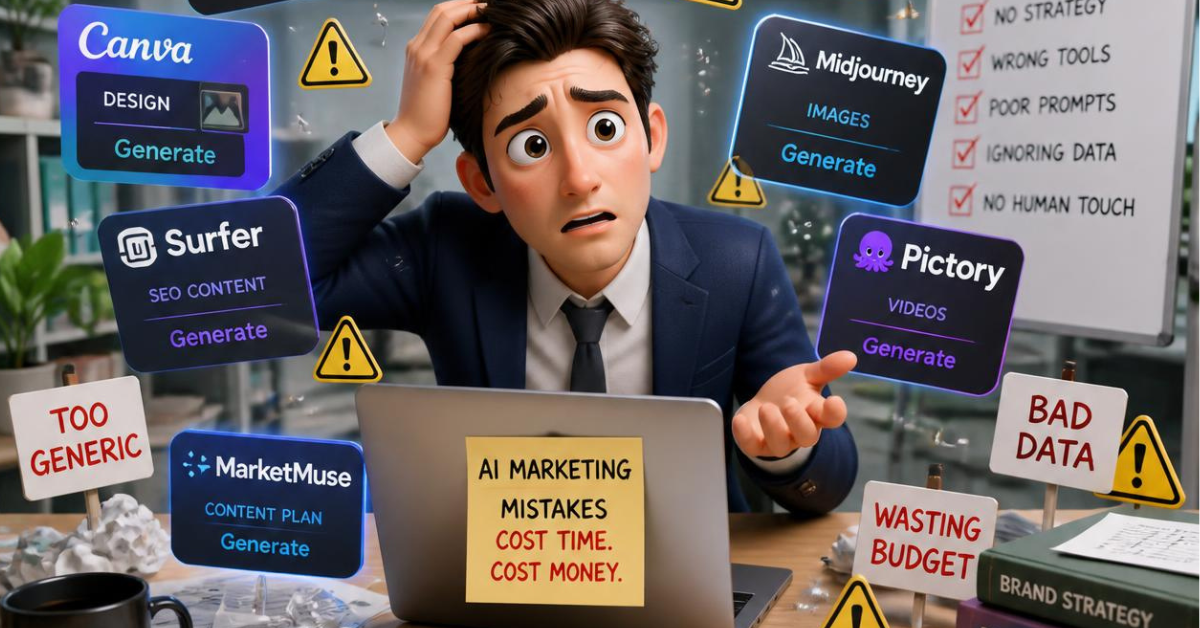
- The AI-drafted content is published without making any edits. It appears general, and users will often be able to discern the difference.
- The wrong job initially. Automating something that customers rarely interact with will waste the initial phase.
- It is not a good idea to treat AI instruments in the manner of “set to forget. ” The segments, the prompts and automated systems require periodic review to ensure that your company and customer alter.
- Do not take care of privacy concerns with data. Customer chat numbers and phone numbers being transmitted to third-party tools must be treated with the same level of care as other data from a customer — examine what tools do with the data prior to transferring it.
- It’s tempting to chase every new tool. The market changes quickly and it’s tempting to change tools each quarter. A tool’s depth usually outperforms breadth across five.
The AI Marketing Starter Checklist
For Indian small-scale entrepreneurs, MSME creators, as well as D2C brands. A one-page action plan that will help you decide the best AI tool to test first and also how to avoid making mistakes that cost founders’ time and money.
STEP 1 — Find your biggest time drain
- Choose the one that eats the most hours of your current week:
- Responding to the same questions from customers time and time again (stock price, cost delivery, time of delivery)
- Writing product descriptions, captions, or email content
- Deciding whom to advertise and the amount to spend
- Identifying who to follow-up with, and how to do it.
- Reacting to Instagram/Google reviews and comments
Step 2: Find it in the correct start tool
- Begin with one tool only. You can add a second tool once this one is working without issue.
- Repetitive customer questions –Begin using WhatsApp Automating business (handles questions as well as stock checks, order status 24 hours a day)
- Content and captions
- Begin with a general AI writing assistant for your initial drafts. Then, edit them to improve the tone.
- Ad targeting and budget – Utilize to use the integrated AI optimization within Meta Ads / Google Ads prior to purchasing a separate tool.
- Customer follow-ups – Start by using the AI segmentation tools already integrated into your CRM or email platform.
- Reputation and reviews – Use AI to draft replies to routine reviews; write 1-2 star responses yourself.
Step 3 : Set up the system securely
- Make sure to have a human review option on all customer-facing items for the initial few months
- Find out what the software does with your customer’s data before connecting it.
- Note down the tone of your brand in 3-4 lines to ensure that your AI drafts look exactly like you and not like generic.
- Select a metric you want to track before and after (hours saved and response time or the conversion rate)
- Create a reminder on your calendar to look over the results of the tool within 30 days.
Step 4 : Make sure you avoid these common mistakes
- Publishing AI-drafted content and not editing — the text reads generic and customers are able to tell.
- Automating a job that your customers seldom have interaction with, and not your main bottleneck
- The idea of treating AI devices in the same way as “set and forget” -prompts and segments require periodic reviews
- The pursuit of every new tool and device that is launched instead of digging into one.
None of this requires a big budget, a technical team, or a complete overhaul of how you market your business. The small businesses seeing real results with AI aren’t the ones using the most tools — they’re the ones who picked one genuine bottleneck, automated it well, and kept a human in the loop where it actually matters.
Start small. Measure honestly. Let the tool earn the next investment.
AI marketing isn’t going to build your brand for you — but it can free up the hours you need to build it yourself.
FAQS
Are AI marketing costly for small-sized businesses not necessarily.
There are many WhatsApp automation tools and email programs start at a price of the low hundreds to just a few thousand rupees a month. In addition, many general-purpose AI assistants provide usable free different levels. The most expensive cost is typically the time it takes to set things up in a proper manner and not necessarily the cost of subscription.
Can AI write my marketing content?
It's able to write it up -- captions and product descriptions, emails topics, and blog outline. This shouldn't be the last word. Examine each AI draft to ensure accuracy, tone and cultural compatibility before it's live, particularly any aspect that is aimed at customers.
How many HTML AI tools do small-sized businesses employ for their small-scale business operations in India?
The most commonly used start-ups are WhatsApp Tools for Business Automation to automate customer responses as well as general AI assistants (like ChatGPT or Claude) to create content and AI tools already integrated into CRM and email tools for segmentation as well as reporting.
Do you think AI take over marketing firms?
Unlikely in the near term. AI is changing what agencies do — more strategy and oversight, less manual execution — but judgment, creative direction, and crisis handling still need a human agency partner, especially for businesses without in-house marketing expertise.