

Artificial Intelligence
The Internet May Have A New Problem: Too Much Good Content
For years, marketers faced one main challenge: creating enough content.
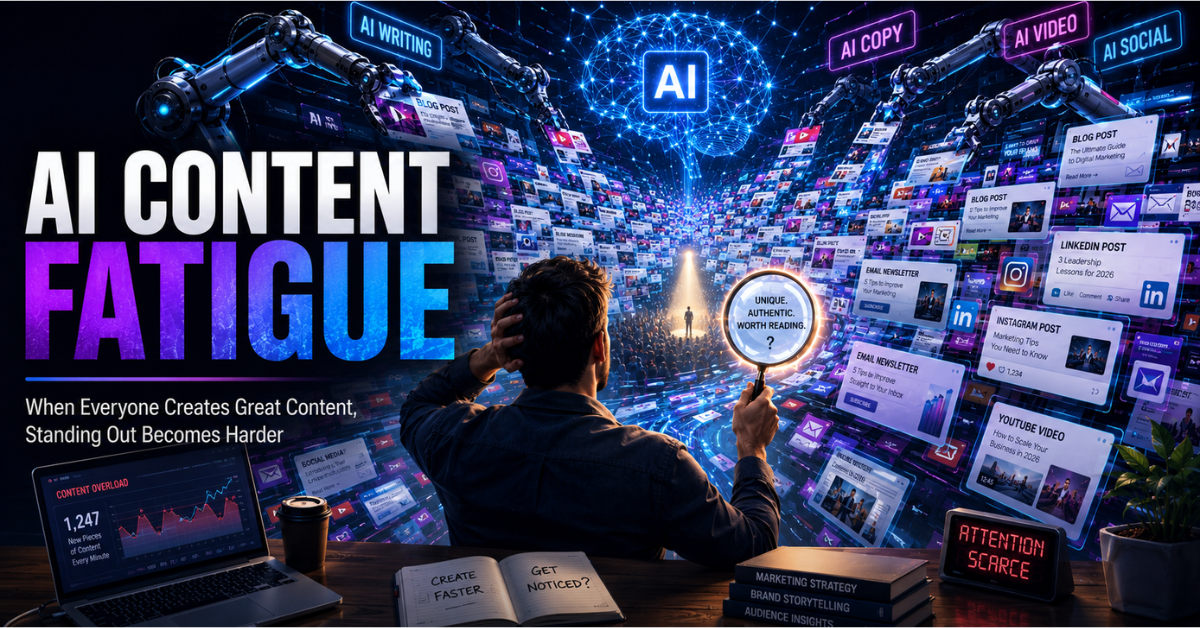
Today, AI has mostly solved that problem. According to HubSpot’s State of Marketing Report, nearly 80% of marketers now use AI in some part of their workflow. This allows tasks that once took hours to be completed in minutes. The rise of AI marketing, AI writing, and AI copy tools has changed how businesses approach content creation.
At the same time, content production has exploded. More than 500 hours of video are uploaded to YouTube every minute, while millions of emails and social media posts compete for attention every day. The amount of digital content being created is growing faster than ever.
This creates an interesting situation. Creating content has become easier than ever, yet getting attention has become harder than ever. The internet may no longer have a content shortage—it may have a content surplus. And that’s where AI Content Fatigue begins.
What If The Problem Isn’t Bad Content?
When content performs poorly, most businesses assume the problem is quality. Maybe the writing isn’t strong enough, the visuals need work, or the messaging isn’t clear.
But AI has changed the game.
According to Salesforce’s State of Marketing research, marketers increasingly use AI for content creation, idea generation , and campaign optimisation. As a result, even small businesses can now produce polished blogs, professional social media posts, and brand content on a large scale.
The issue isn’t that content quality is getting worse. The issue is that quality is no longer unique. When thousands of businesses use similar tools, prompts, and frameworks, the output often starts to feel familiar.
AI Content Fatigue isn’t a reaction to bad content. It’s a reaction to predictable content.
Have You Noticed That Everything Is Starting To Sound The Same?
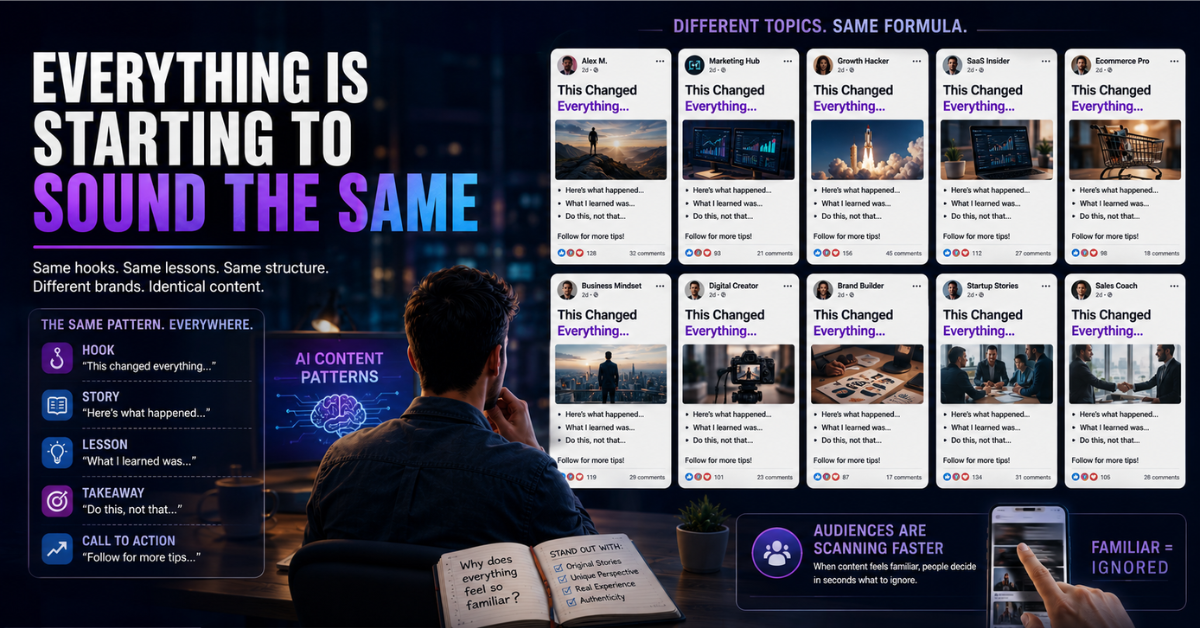
Spend a few minutes scrolling through LinkedIn or Instagram. You’ll see different creators discussing different industries and topics, yet many posts feel surprisingly similar.
The same hooks, storytelling patterns, lessons, and conclusions appear repeatedly. This isn’t necessarily because creators are copying one another. More often, they’re learning from the same successful formats and using tools trained on similar content patterns.
A helpful comparison is stock photography. Years ago, websites were filled with the same smiling office teams, staged handshakes, and perfectly posed boardroom meetings. Eventually, people stopped noticing them because they had seen them too many times before.
Content may be entering a similar phase. Research from Nielsen Norman Group shows that people mainly scan online content rather than read every word. When content feels familiar, audiences become even quicker at deciding what to ignore.
The challenge isn’t quality. It’s familiarity.
When Everyone Creates Good Content, What Happens Next?
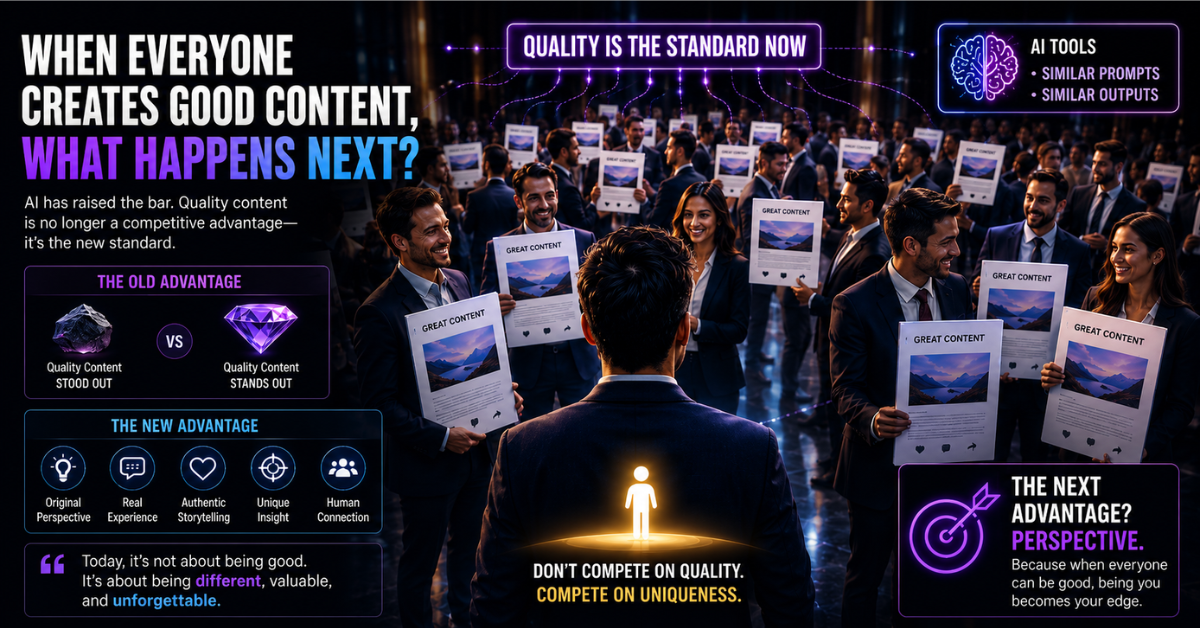
For years, quality was a competitive advantage. If your content was better written, better designed, or more useful than your competitors’, you stood out.
Today, quality is becoming the norm.
Imagine walking into a room where everyone is wearing a perfectly tailored suit. Nobody looks bad. In fact, everyone looks impressive. Yet nobody immediately stands out.
Modern marketing may be experiencing the same change. As AI raises the overall quality of content across the internet, audiences are beginning to look beyond polish. They’re paying closer attention to originality, unique perspective, and experiences that feel genuine.
For years, quality was the advantage. The next advantage may be perspective because when everyone can create good content, being good is no longer enough.
Read More>>
The Most Valuable Thing AI Still Can’t Generate
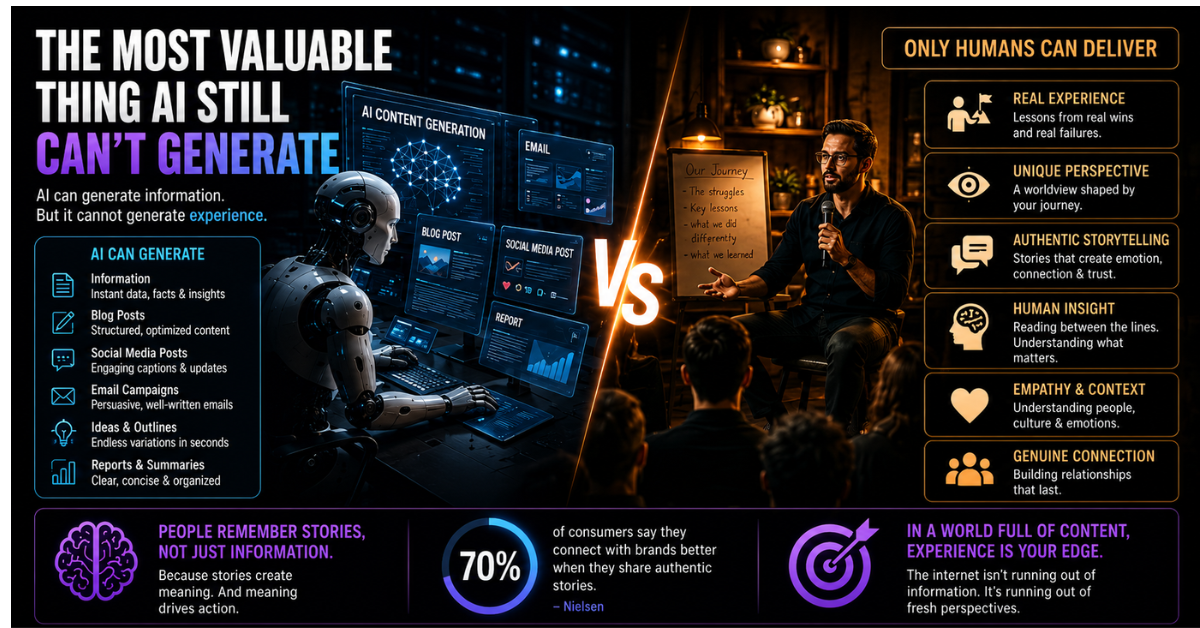
AI can generate information, but it cannot generate experience.
A founder sharing lessons from a failed launch, a marketer explaining why a campaign failed, or a business revealing what happened behind the scenes of a successful project brings something AI cannot replicate: real experience.
Research in psychology has consistently shown that people remember stories better than isolated facts because storytelling creates emotional context and meaning. That’s why authenticity continues to stand out despite the growth of AI-generated content.
People don’t just want information. They want perspective, real stories, and experiences they can learn from. The internet isn’t running out of information; it’s running out of fresh perspectives.
The Future Isn’t Human Vs AI. It’s Something More Interesting.
Much of the discussion around AI focuses on whether it will replace human creators. That’s probably not the right question.
A better question is:
What becomes more valuable when everyone has access to the same tools?
The answer may be originality, creative thinking, and unique perspective.
AI will continue to make content creation faster and more efficient. At the same time, qualities like creativity, judgment, experience, and perspective may become even more valuable because they are much harder to automate.
This change is already visible. According to Edelman’s Trust research, consumers are significantly more likely to engage with brands they see as authentic and trustworthy. Understanding consumer behavior will become increasingly important as businesses compete for attention.
The businesses that succeed won’t reject AI. They’ll use it strategically. AI will help them create faster, while human insight, brand storytelling, and authenticity will help them stand out.
Read More>>
Conclusion
For years, the challenge in marketing was creating enough content.
Today, AI has made content creation faster, easier, and more accessible than ever before. But as more businesses gain access to the same tools, quality alone is no longer enough to stand out.
The brands that win won’t necessarily be the ones producing the most content. They’ll be the ones sharing the most originality, genuine experiences, meaningful perspective, and authentic brand storytelling.
AI can help create content on a large scale, but being memorable is still a human advantage. In a world full of good content, that advantage may become more valuable than ever.